
Your Body Was Never Fighting You. It Was Fighting Broken Signals.
Every year, millions of people lose meaningful amounts of weight — and then watch it return. Not because they lacked effort. Not because their plan was wrong. Because the biological mechanism that determines whether weight loss is permanent was never addressed. And until you understand what that mechanism is, every intervention you try is working around the actual problem rather than through it.
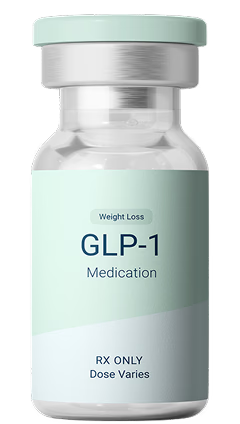
The mechanism is a hormone called GLP-1 — glucagon-like peptide-1. It's produced in your small intestine within minutes of eating and travels directly to the hypothalamus, where it delivers a signal: satiated. Enough. The meal is complete. When this signal functions correctly, portions feel natural, hunger is proportional, and the body readily draws on fat stores between meals. When it's disrupted — through years of processed food, chronic stress, repeated caloric restriction — the signal weakens. The brain stops getting the message. And hunger becomes a constant, low-grade emergency that no amount of discipline can reliably override.
This is the mechanism that every obesity specialist, endocrinologist, and metabolic researcher I have spoken with over the past two years returns to. It is also the mechanism that the most effective clinical weight loss programs in the world now specifically target.

The Biology
Why Every Diet You've Tried Was Solving the Wrong Problem
When you restrict calories without addressing GLP-1 signaling, your body interprets the deficit as a food shortage — not a health intervention. Leptin, the hormone signaling fullness, drops sharply. Ghrelin, the hormone driving hunger, rises. Resting metabolic rate falls by more than the weight loss alone would predict. And these changes don't reverse when you reach your goal weight. Research from some of the longest-running obesity studies shows they can persist for six years or more after the diet ends.
This explains the pattern that nearly everyone who has dieted recognises: the weight comes back, and it brings company. The biological set-point has shifted. The hunger signals are recalibrated to push consumption higher. The person concludes they are the problem. They are not. The intervention was the problem — specifically, its failure to address the hormonal environment that makes weight loss either temporary or permanent.

GLP-1 receptor activation works at the cellular level — resetting the signaling pathway that tells the brain the body has had enough. It isn't appetite suppression. It's signal restoration.
"Conventional dieting treats weight like an accounting problem — calories in, calories out. The endocrine system doesn't work that way. You can balance the accounts perfectly and still lose to the hormones. Addressing the hormonal environment isn't complementary to weight loss. For most patients, it's the prerequisite."
— Dr. Alicia Reyes, MD · BodySignal Journal Contributing Editor
A review of 14 supervised GLP-1 trials found that participants receiving individual clinical assessment and ongoing monitoring lost an average of 14.8% of total body weight at 12 months — compared to 4.3% in standard dietary control groups. At 24 months, 71% of supervised participants maintained clinically significant weight loss. The primary differentiating variables: proper titration, individual protocol design, and continuous clinical contact.
Why Supervision Changes Everything
The Gap Between "GLP-1 Access" and Clinical GLP-1 Care
There is a critical distinction that gets lost in the marketing noise around GLP-1. The outcomes data — the 14–20% body weight reductions that have changed how the medical community thinks about metabolic weight management — comes from supervised clinical programs. Programs where patients were individually assessed before starting. Where dosing was titrated based on actual response. Where a clinical team was monitoring and adjusting throughout.
Unsupervised access to the same compounds produces significantly different results. The titration schedule matters. The individual metabolic picture matters. The ongoing clinical contact matters. Getting one of these variables wrong doesn't just reduce effectiveness — it produces the experiences that lead people to conclude that GLP-1 approaches "didn't work for them," when in many cases the delivery was the problem rather than the mechanism.

"Every patient who comes to me saying 'GLP-1 didn't work for me' — when I dig into what they actually did, almost always the assessment was inadequate, the titration was rushed, or there was no real monitoring. The mechanism works. The delivery matters enormously."
What Proper Clinical Supervision Includes
- 🧬Full metabolic assessment before the protocol begins. Your health history, current medications, and metabolic markers — reviewed by a licensed clinician. Not a checkbox. The clinical picture that makes the protocol specific to you rather than generic.
- 💊Prescription-grade GLP-1 medication. Not a botanical formula claiming GLP-1 "support." The actual receptor-acting medication that the clinical trial outcomes are built on — prescribed based on your individual assessment.
- 📊Titration based on your actual response. Starting dose, escalation schedule, and adjustments driven by how your body specifically responds. This is the variable with the highest impact on both tolerability and outcome — and it requires clinical access to do correctly.
- 🔄Ongoing clinical monitoring and adjustment. Your metabolism changes during the program. Effective protocols change with it — based on what is actually happening, not a fixed schedule set on day one.
- 🎯Structured maintenance transition planning. The hormonal challenges of the post-loss phase are distinct from those of the loss phase. Programs that don't plan for this explicitly produce patients who regain on a supervised schedule. Quality programs address it as a distinct phase.

The intake assessment is the data that makes a supervised protocol different from a generic one. What the clinical team learns in the first appointment shapes every decision that follows.
The Programs
GLP-1 vs GLP-1+GIP: The Clinical Difference
TrimRx provides supervised access to two distinct protocol tracks. Both require individual assessment and prescription authorization. The distinction between them is clinically meaningful and worth understanding before your intake appointment.
| Feature | GLP-1 Program | GLP-1 + GIP Program |
|---|---|---|
| Mechanism | Single-pathway GLP-1 receptor activation | Dual GLP-1 + GIP receptor activation |
| Clinical Supervision | ✓ Full | ✓ Full |
| Individual Assessment | ✓ Included | ✓ Included |
| Avg. Trial Outcomes | ~15% total body weight reduction | ~20% total body weight reduction |
| Ongoing Monitoring | ✓ Yes | ✓ Yes |
| Prescription Required | ✓ Rx Only | ✓ Rx Only |
GIP activation — the additional pathway in the combined program — works primarily on fat cell metabolism and energy expenditure, complementing GLP-1's role in hunger signaling. Combined protocols have shown meaningfully higher outcomes in clinical trials over the past three years. Which program is appropriate for you depends on your individual metabolic profile — a determination made during your clinical intake.
Patient Outcomes
What Patients Report From the Program
"The description I keep giving people is: I used to think about food constantly. Not cravings exactly — just this continuous low-level preoccupation. By week four, that had mostly stopped. I'm down 32 pounds in five months."
"I specifically asked my provider at TrimRx to walk me through the titration plan before we started. They did, and they adjusted it twice based on how I was responding. That felt like actual medical care, not a subscription."
"Eleven years post-partum weight that survived every diet I tried. Twenty-two pounds gone in three months. My doctor asked what changed at my annual physical. I told her. She said she wished more of her patients had access to this."
"What stands out is the plateau that never came. Every diet I tried hit a wall at month two. This is month six and I'm still losing — slowly, but steadily. My clinical team adjusted the protocol twice. That adaptability made the difference."
Individual results vary. Testimonials reflect personal experiences and are not guarantees of identical outcomes.
Editorial Conclusion
What This Means If You've Tried Everything
If you have dieted repeatedly and watched the weight return — often more than was lost — the most honest explanation is not personal failure. It is that the interventions you used were not designed to address the mechanism driving the regain. Caloric restriction manages energy balance. It does not restore the hormonal signaling environment that makes that balance sustainable over years rather than months.
The clinical evidence for supervised GLP-1 protocols is now substantial enough that it has changed how the medical community discusses obesity treatment. What was previously available only through specialty obesity clinics — at costs that made it inaccessible to most people — is now accessible through programs like TrimRx that bring licensed clinical supervision to the process without requiring a hospital referral or a specialist waitlist.
The first step is a clinical assessment. It costs nothing to start, requires no commitment, and gives you and a licensed clinician the information needed to determine whether a supervised GLP-1 protocol is the right fit for your specific metabolic picture.
BodySignal Journal earns affiliate commissions when readers access TrimRx services through links on this page. This does not influence our editorial content or the clinical research we cite. We cover TrimRx because it represents the supervised clinical model the peer-reviewed literature supports — not because of the commission structure.
Editorial Disclosure: This article is published by BodySignal Journal, an independent editorial website. This page contains affiliate links. If you access TrimRx services through our links, we may earn a commission at no additional cost to you. Affiliate relationships do not influence editorial content or the research we reference.
Health Disclaimer: The information in this article is for general informational and educational purposes only. It does not constitute medical advice and is not a substitute for consultation with a qualified physician. Individual results vary significantly. Always consult a licensed healthcare provider before beginning any weight management program, particularly if you have pre-existing conditions, take prescription medications, are pregnant or nursing, or have a history of eating disorders.
Advertising Disclosure: This page contains paid affiliate content. The editorial presentation of TrimRx reflects both genuine assessment of its supervised clinical model and a compensation relationship. Readers should weigh both when evaluating this content.
Results Disclaimer: Clinical findings referenced in this article are drawn from peer-reviewed literature for educational context. They do not represent guaranteed individual outcomes. Real-world results vary based on individual health status, protocol adherence, and clinical management.